
Introduction: Two Currents, One World
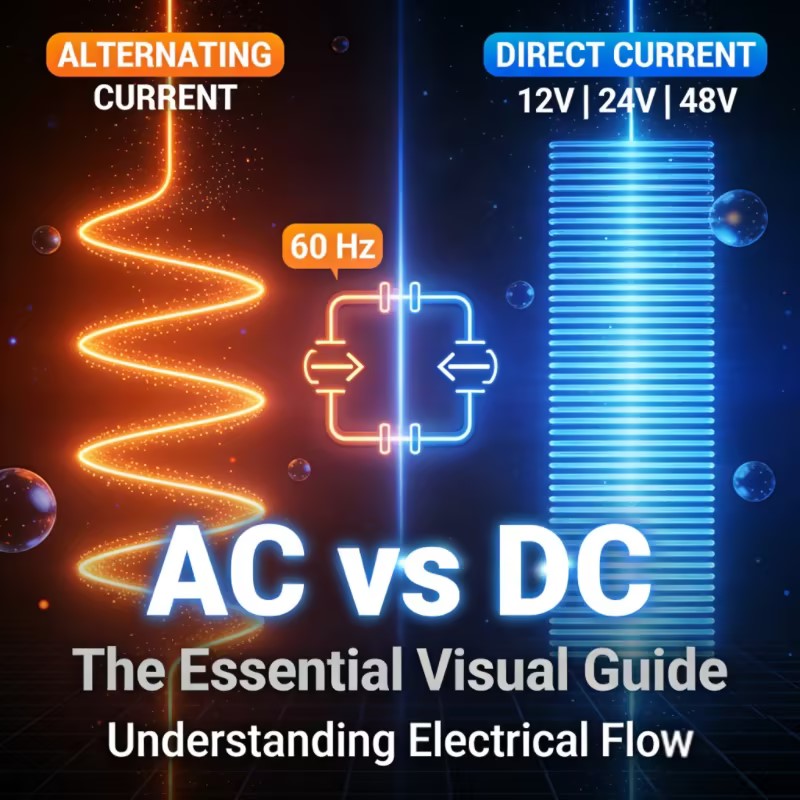
Electricity comes in two basic forms: Alternating Current (AC) and Direct Current (DC). AC moves back and forth like ocean waves, while DC flows steadily in one direction like a river. Understanding this difference is essential for working with solar power, RV systems, and modern electronics.

What Is Alternating Current?
AC is electricity that changes direction periodically.
Key Characteristics:
- Changes direction 50-60 times per second (50/60 Hz)
- Voltage oscillates between positive and negative
- Creates wave-like pattern (sine wave)
- Easy voltage change with transformers
Where AC Is Used:
- Household wall outlets
- Power transmission grids
- Large appliances (refrigerators, AC units)
- Industrial equipment
Why AC Dominates Grids:
AC transmits efficiently over long distances. Transformers easily "step up" voltage for transmission (reducing loss), then "step down" for safe home use.
What Is Direct Current?
DC is electricity that flows steadily in one direction.
Key Characteristics:
- Constant one-direction flow
- Stable voltage (decreases slowly as batteries discharge)
- Shows as straight line on graphs
- Can be stored in batteries
Where DC Is Used:
- All batteries (phones, cars, solar)
- Inside electronic devices
- Solar panels (natural DC producers)
- Vehicle electrical systems
- USB power (5V DC)
- LED lighting
Why DC Powers Digital World:
While AC delivers power to homes, electronics need stable DC voltage. Every device has an AC-to-DC adapter.
Difference Between AC and DC
This comparison diagram highlights the fundamental differences between alternating current (AC) and direct current (DC). Note how the undulating nature of AC contrasts sharply with the linear flow of DC—it is precisely this core distinction that explains why each type of current offers distinct advantages in different applications.

AC vs. DC: Quick Comparison Table
| Aspect | Alternating Current (AC) | Direct Current (DC) |
|---|---|---|
| Flow Direction | Changes periodically | Constant one-way |
| Voltage Pattern | Sine wave | Straight line |
| Frequency | 50/60 Hz | 0 Hz |
| Transmission | Excellent long distance | Poor long distance |
| Voltage Change | Easy with transformers | Needs converters |
| Storage | Cannot store directly | Easily stored in batteries |
| Safety | More dangerous (High Voltage) | Safer at low voltage |
| Common Sources | Power grid, generators | Batteries, solar panels |
| Common Uses | Homes, factories, large motors | Electronics, vehicles, solar |
Simple Explanations
Electron Movement- AC: Electrons "wiggle in place" like people in crowded train
- DC: Electrons "march forward" like soldiers in formation

Solar System Example
Solar Panels (DC) → Charge Controller → Batteries (DC) → [Inverter → AC Devices]
- DC: Lights, water pumps, USB outlets (from batteries)
- AC: AC units, microwaves (via inverter or shore power)

Conversion Devices
- AC to DC: Chargers, power adapters
- DC to AC: Inverters
- DC to DC: Converters (change voltage levels)
FAQs
Q1: Why homes use AC but devices need DC?
AC transmits more efficiently from plants to homes. But electronics need stable DC voltage, so every device has an AC-to-DC adapter.
Q2: Which is more dangerous?
At household voltage (120V/240V), AC is generally more dangerous as its alternating nature causes muscle contraction. Low-voltage DC (like 12V in RVs) is safer for DIY.
Q3: Can AC devices run on DC?
Not directly. Most AC devices need AC's specific wave pattern. You must use an inverter to convert DC to AC for standard appliances.
Q4: Why solar panels produce DC?
Solar panels naturally generate DC. Sunlight creates one-way electron flow in photovoltaic cells. Systems use inverters to convert to AC for home use.
Q5: For off-grid, DC or AC appliances?
Prefer DC when possible:
DC advantages: No conversion loss, more efficient, better battery life
AC needs: Required for high-power devices (AC units, microwaves)
Best practice: Use DC for lights/pumps, AC via inverter for large appliances
Q6: Will we switch to DC grids?
More DC microgrids may appear as solar panels/batteries are native DC, modern electronics use DC internally, and fewer conversions improve efficiency. But completely replacing AC grids is unlikely.
Key Takeaways
- AC and DC are partners—AC delivers efficiently, DC powers devices
- Minimize conversions—Each AC/DC conversion loses 10-20% efficiency
- Safety matters—Respect differences, use proper conversion equipment
- Choose wisely—Select DC appliances when possible in solar/RV systems
- Right tools—A multimeter measuring both AC and DC is essential
Conclusion
AC and DC work together to power our world. Understanding their differences helps you design better systems, troubleshoot problems, and make smarter energy choices. Remember: AC dances like waves, DC marches steadily—our electrical world needs both rhythms.
Share:
How to Store LiFePO4 Batteries Properly: A Complete Storage Guide
How to Charge LiFePO4 Batteries Correctly