
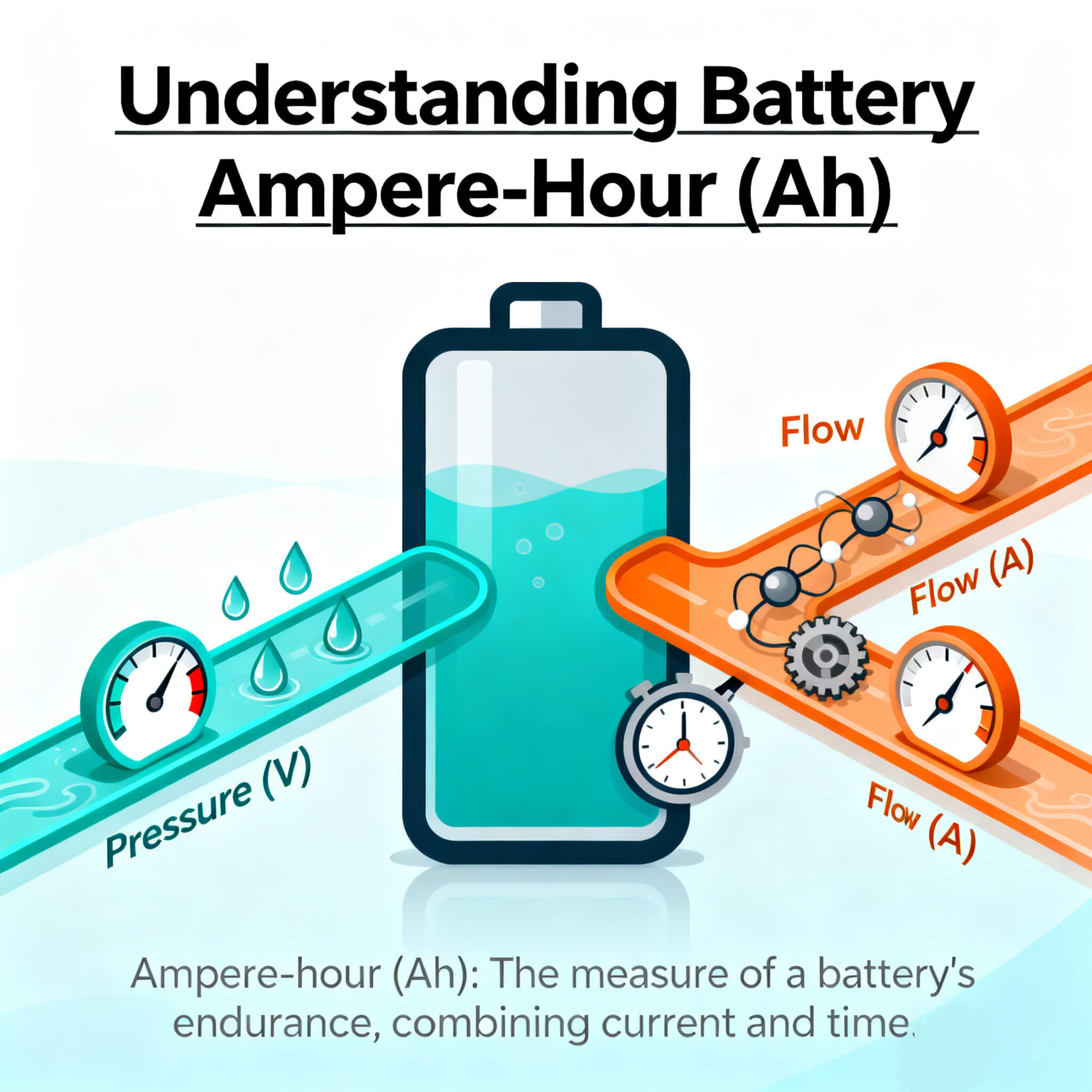
In our daily lives, batteries power countless devices, from the phones in our pockets to the electric vehicles on the road. When learning about batteries, we often encounter terms like "Voltage" and "Ampere-hour (Ah)." If Voltage (Volts) determines how strong the battery's "push" is, then the Ampere-hour (Ah) defines how long the battery's "endurance" lasts—it measures the battery's capacity.
What is Battery Ampere-Hour (Ah)?
The Ampere-hour (Ah) is a unit that measures a battery's electrical storage capacity. It tells us how much electric current a battery can deliver continuously before being fully discharged.
Simply put:
1 Ah means a battery can deliver 1 Ampere (A) of current for 1 hour continuously.
Similarly, a 1Ah battery can also deliver 0.5A of current for 2 hours (because 0.5A × 2h = 1 Ah).
You can think of it as a water tank:
Amperes (Current) is like the flow rate of water from a tap.
Ampere-hour (Capacity) is like the total volume of water stored in the tank.

A higher flow rate (larger current) empties the tank faster; a larger tank (higher Ah) provides water for a longer duration.
How to Calculate Battery Capacity and Device Runtime?
Using the Ah unit, we can easily estimate how long a battery can power a device.
Basic Formula:
Runtime (hours) = Battery Capacity (Ah) ÷ Device Operating Current (A)
Example:
Suppose you have a power station with a capacity of 20 Ah, and you want to use it to power a mini fridge that operates at 5A.
Runtime = 20 Ah ÷ 5 A = 4 hours
This means, under ideal conditions, this battery can power the mini fridge for about 4 hours.

Important Note: This is a theoretical calculation. Actual usage time is influenced by factors like temperature, battery age, and discharge efficiency.
The Difference Between Amps, Ohms, and Volts
These three are the most fundamental concepts in electricity, collectively describing its behavior. Let's use the water pipe analogy again:
Volt - Voltage (V) - "Pressure"
It's like the water pressure in a pipe. It represents the "force" or potential difference that pushes the electric current.
Role: It determines whether current can flow and how "hard" it is pushed.
Amp - Current (A) - "Flow Rate"
It's like the volume of water flowing through the pipe per unit of time. It represents the amount of charge passing a point in a conductor per unit of time.
Role: It determines how much charge is actually flowing.
Ohm - Resistance (Ω) - "Restriction"
It's like the friction or a narrow section in the pipe that resists water flow. It represents a conductor's opposition to the flow of current.
Role: The greater the resistance, the smaller the current that can flow for a given voltage.

Their relationship is perfectly defined by Ohm's Law: Voltage (V) = Current (I) × Resistance (R). Voltage is the driving force, current is the resulting flow, and resistance restricts that flow.
Alternating Current (AC) VS Direct Current (DC)
Batteries provide Direct Current (DC), which is fundamentally different from the Alternating Current (AC) provided by our household wall outlets.
Direct Current (DC):
Characteristic: Current flows steadily in one direction continuously.
Source: Batteries, solar panels, USB ports.
Use: Almost all portable electronic devices, such as phones, laptops, LED lights, and car electronics.
Alternating Current (AC):
Characteristic: The magnitude and direction of the current change periodically (e.g., 50 times per second in household mains).
Source: Power plants, wall outlets.
Use: Powering homes, businesses, and industries because it can be transmitted over long distances efficiently.

When you use a charger to power your phone, it is essentially performing AC to DC conversion, transforming the AC from the wall outlet into the DC required by the battery.
Is a Higher Ah Always Better?
Not necessarily. Choosing the right Ah rating depends entirely on your needs.
Advantages of Higher Ah:
Longer Runtime: This is the most direct benefit. For scenarios requiring long periods of off-grid use (e.g., camping, long voyages), high-Ah batteries are essential.
Ability to Support Higher-Power Devices: Some high-power devices require large instantaneous current, and high-Ah batteries can typically provide better peak current output.
Costs of Higher Ah:
Heavier and Larger: Capacity is usually proportional to the physical size and weight of the battery. You wouldn't want a car battery-sized cell to power a remote control.
More Expensive: Larger capacity means higher manufacturing costs and, consequently, a higher price.
Longer Charging Time: Filling a larger "water tank" requires more time.
Conclusion: Pursuing battery capacity is a trade-off between runtime, physical size/weight, and cost. Choose what is appropriate, not blindly the largest.
Battery Versatility
From tiny hearing aid batteries to massive grid energy storage systems, batteries with different Ah capacities play irreplaceable roles in various fields:
Low Ah Applications: Watches, remote controls, Bluetooth earbuds (typically tens to hundreds of mAh, where 1Ah = 1000mAh).
Medium Ah Applications: Smartphones, laptops, drones (typically 2Ah to 10Ah).
High Ah Applications: Electric vehicles, home energy storage systems, Uninterruptible Power Supplies (UPS) (typically tens to hundreds of Ah).

Summary: Understanding Ampere-hour (Ah) allows you to select and use batteries from a more professional perspective. It is no longer just an isolated number on a product label but a bridge connecting battery performance to your practical needs. Next time you buy a battery, ask yourself: "How much current does my device need? How long do I want it to run?" The answer will naturally guide you to the battery with the most suitable capacity.
Share:
What is Battery Voltage? Why Does it Matter?
The Ultimate Guide to Power Wheelchair Range: How Far Can You Really Go?