
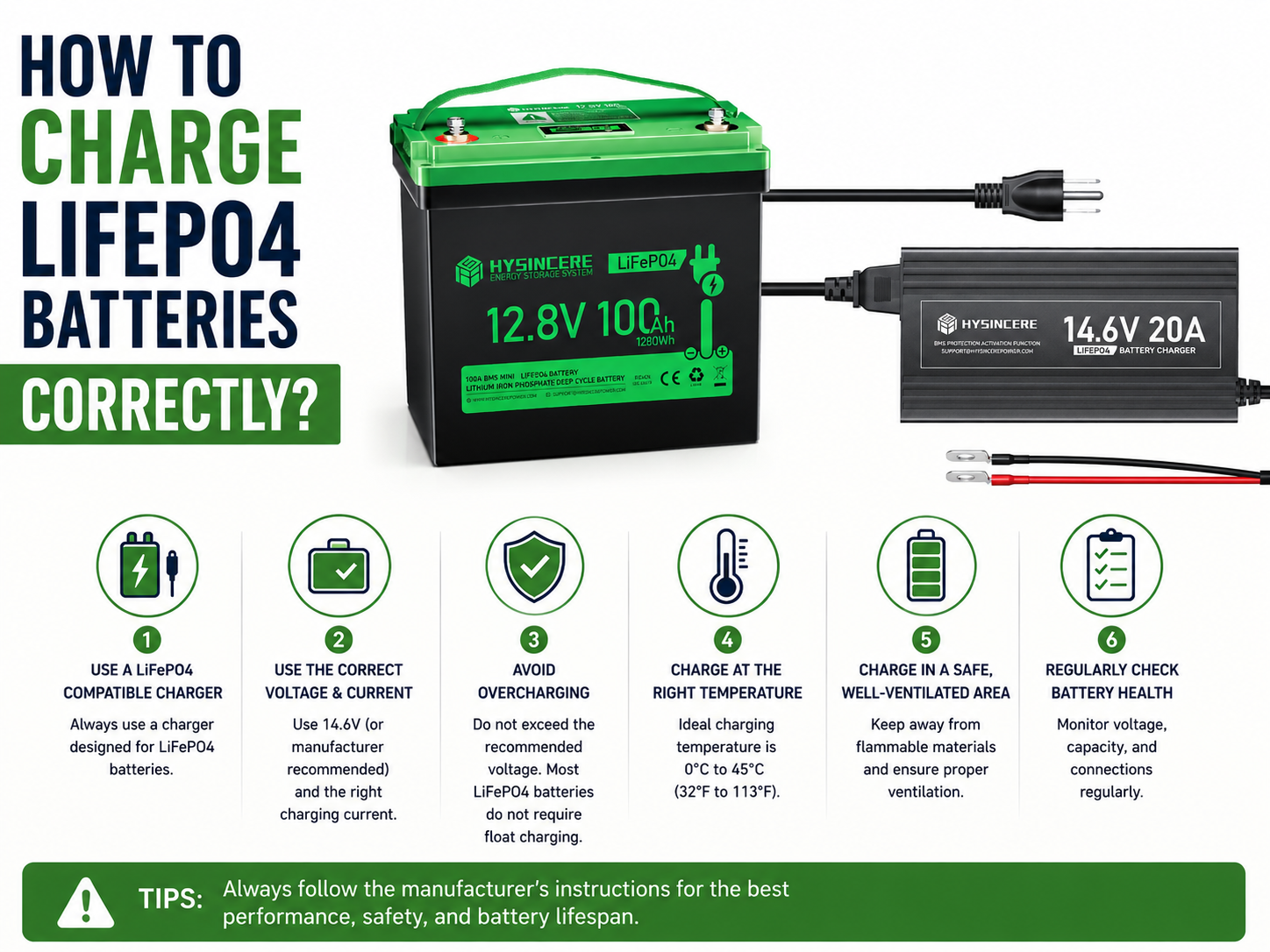
LiFePO4 batteries are increasingly popular in solar energy storage, RVs, and off-grid systems due to their long lifespan and high safety. However, proper charging is essential to ensure performance and extend battery life. This article will introduce the key points for charging LiFePO4 batteries.
Contents
1. Recommended Charge Voltage and Stages
LiFePO4 batteries use the Constant Current/Constant Voltage (CC/CV) charging method, which is completely different from lead-acid batteries.
For a 12.8V LiFePO4 battery, the key parameters are as follows:
- Absorption Voltage: 14.2V – 14.6V (typically 14.4V)
- Float Voltage: 13.4V – 13.8V (optional, many chargers omit this stage)
- Cut-off Current: 0.05C (e.g., 5A for a 100Ah battery)
The charging process is divided into three stages:
- Constant Current Stage: The charger supplies a constant current (usually 0.2C to 0.5C) to the battery, and the voltage rises steadily until it reaches the absorption setpoint.
- Constant Voltage Stage: The voltage remains constant, and the current gradually decreases. When the current drops below 0.05C, it indicates the battery is fully charged.
- Float Stage (Optional): Some chargers switch to a lower voltage to maintain a full charge. However, since LiFePO4 batteries have a very low self-discharge rate, they can be disconnected directly after charging.
Important Note: LiFePO4 batteries do not require an equalization charge. Never apply the equalization mode used for lead-acid batteries.
2. Charger Types and Settings
Choosing the right charger is crucial.
Dedicated LiFePO4 chargers are the safest choice. These chargers come pre-programmed with the correct CC/CV charging curve and accurate voltage (14.4V or 14.6V). They often also feature a 0V activation (BMS wake-up) function to revive batteries that have entered protection mode due to over-discharge.
Can you use a lead-acid charger? Generally not recommended. Most lead-acid chargers have incorrect voltage curves and may stop charging prematurely, leaving the battery at only 80-90% capacity.
Key Settings to Check:
- Charge Voltage: Confirm it is between 14.2V and 14.6V.
- Charge Current: Recommended range is 0.2C – 0.5C (0.2C is more beneficial for extending battery life).
- Temperature Compensation: Not needed for LiFePO4 batteries; this feature should be disabled.

3. Solar / MPPT Charging Tips
For solar systems, the choice of charge controller directly impacts charging efficiency.
MPPT vs. PWM: MPPT (Maximum Power Point Tracking) controllers are more efficient. They convert the high voltage from solar panels to the correct charging voltage for the battery and allow for customized charging parameters, making them the preferred choice. PWM (Pulse Width Modulation) controllers can be used but are less efficient and may not allow voltage adjustments.
MPPT Controller Settings:
- Set the battery type to "LiFePO4" or "User Defined".
- Set the absorption voltage to 14.4V – 14.6V.
- Set the float voltage to 13.4V – 13.8V (or disable float completely).
- Enable the low-temperature cut-off function to stop charging when the battery temperature falls below 0°C.
- If an external temperature sensor is available, connect and use it.

Array Sizing: Ensure the charging current does not exceed the battery's recommended limit (usually 0.5C). For example, the maximum charging current for a 100Ah battery should not exceed 50A.
4. Cold Temperature Charging
- Absolutely Prohibited: Never charge a LiFePO4 battery below 0°C!
- Why is it dangerous? At low temperatures, the internal resistance of the battery increases dramatically. Forcing a charge can cause lithium metal to plate on the anode surface, leading to permanent capacity loss, internal short circuits, and even the risk of thermal runaway.
How to Handle Charging in Cold Environments:
- Use a battery with built-in low-temperature protection. The BMS will automatically disable charging below 0°C.
- Install an external temperature sensor that works with your charger or controller.
- Before charging, move the battery to a warm environment (above 10°C) and allow it to warm up naturally.
- Insulate the battery enclosure to reduce heat loss.

Discharging in Cold Temperatures: Discharging at low temperatures is safe, but the usable capacity will be reduced, and the voltage will drop faster.
5. Troubleshooting Charging Issues
- Battery Won't Charge / Shows 0V: The BMS may have entered protection mode due to over-discharge. Use a charger with a BMS wake-up function to activate it.
- Battery Never Reaches 100% / Undercharged: The charge voltage may be set too low. Check the charger's output voltage and ensure it is between 14.4V and 14.6V.
- Battery Gets Hot While Charging: The current may be too high, or a cell may be damaged. Stop charging immediately and check if the current exceeds 0.5C. If the current is normal but the battery temperature exceeds 50°C, contact the manufacturer.
- Controller Shows "Overvoltage" Error: Check if the absorption voltage setting exceeds the battery's maximum (14.6V). If using a PWM controller, ensure the solar panel voltage is not too high.
- Battery Drains Quickly After Full Charge: The battery may not have been truly fully charged, or the cells may be unbalanced. Try charging at a low current (0.05C) for several hours to balance the cells.
Summary
Charging LiFePO4 batteries correctly is not complicated. Just remember these key points:
- Voltage: 14.2V – 14.6V (for 12V systems)
- Current: 0.2C – 0.5C (0.2C is better for longevity)
- Charging Curve: Use the CC/CV (Constant Current/Constant Voltage) method
- Cold Temperature Rule: Absolutely never charge below 0°C
- Charger: Choose a dedicated LiFePO4 charger with a 0V activation (BMS wake-up) function
By following these basic principles, your LiFePO4 battery will provide thousands of reliable cycles, delivering its expected performance and lifespan.
Share:
AC vs DC: The Essential Guide to Electrical Currents
Hysincere Power at Germany Exhibition 2026: Showcasing Lithium Battery Innovation
1 comment
When are you going to make a lithium battery I can use as a cranking battery to start my 250hsp outboard motor? Thank you