
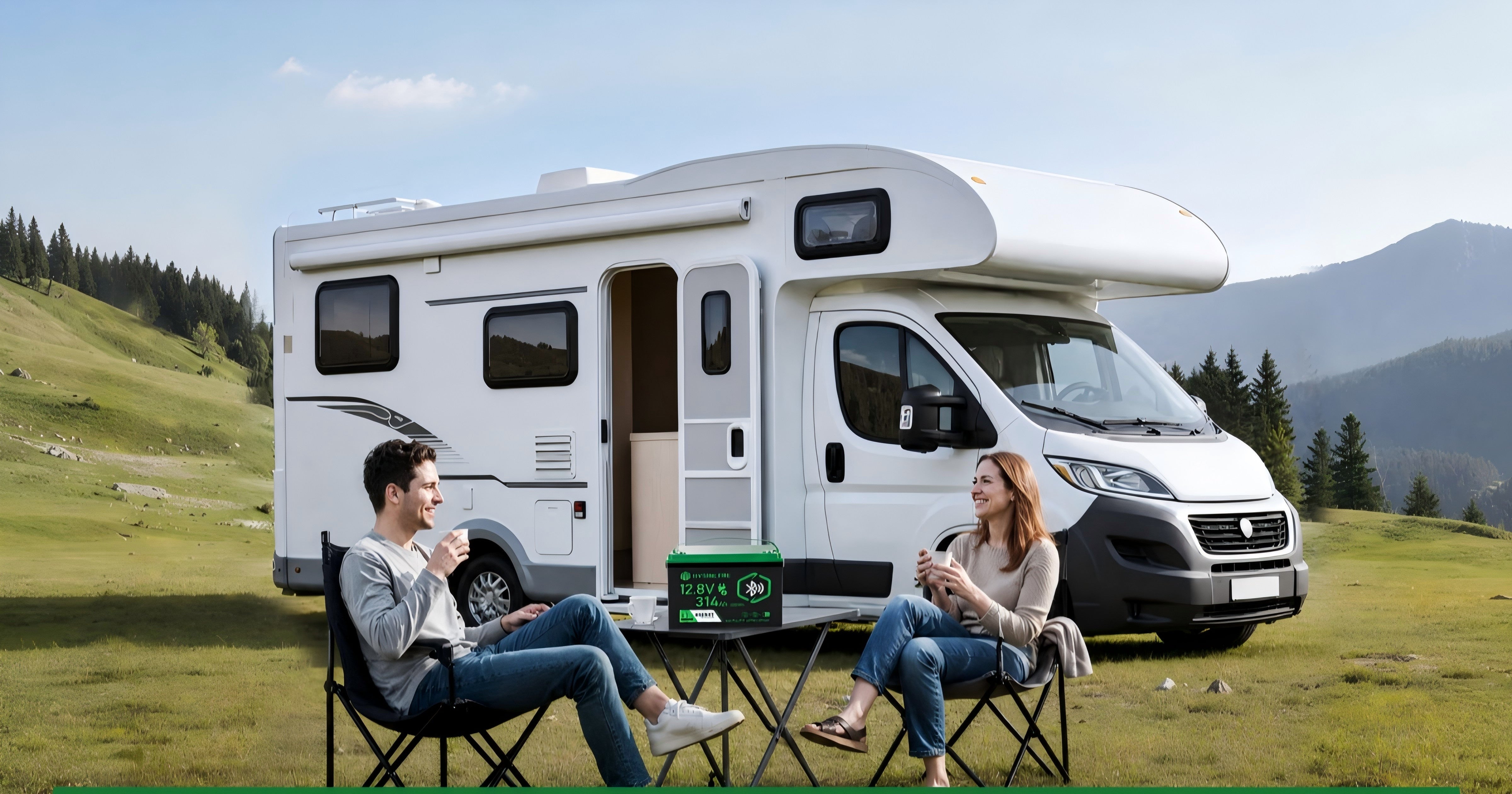
Outdoor cooking has come a long way. For many campers, RV travelers, and off-grid adventurers, a simple camp stove is no longer the only option. Electric kettles, induction cooktops, coffee makers, portable refrigerators, electric grills, and other appliances can make outdoor cooking much more convenient.
But there is one important question to answer before you plug everything in:
How much battery power do you actually need for outdoor cooking?
The answer depends on your cooking habits, the appliances you use, how long you use them, and whether you have solar charging available.
In this guide, we'll explain how to estimate your power needs and how a LiFePO4 battery system can help you build a reliable outdoor kitchen.
1. Start With Your Outdoor Cooking Style
Before choosing a battery, think about how you normally cook outdoors.
Not everyone needs a large battery bank. Your ideal setup depends on whether you simply want to boil water or run a complete electric kitchen.
Lightweight Cookin
If you mainly need:
- Coffee or tea
- Instant noodles
- Hot water
- Small meals
you may only need a low-power electric kettle or a small induction cooktop.
For occasional cooking, a compact 12V LiFePO4 battery can provide a convenient source of stored energy without adding unnecessary weight.
Full Outdoor Kitchen
If you want to use several appliances throughout the day, your energy requirements will be much higher.
A typical setup might include:
- Induction cooktop
- Electric kettle
- Coffee maker
- Electric grill
- Portable refrigerator
- LED lights
- Phone and laptop chargers
In this situation, battery capacity becomes much more important.
2. Understand Watts, Volts, Amps and Watt-Hours
You don't need to be an electrical engineer to plan your outdoor power system.
There are four basic terms worth understanding.
Watts (W): How Much Power an Appliance Uses
Watts tell you how much electrical power an appliance requires while operating.
For example:
| Appliance | Typical Power |
| LED light | 5–20W |
| Portable refrigerator | 40–80W |
| Coffee maker | 800–1,200W |
| Electric kettle | 1,000–1,500W |
| Induction cooktop | 1,000–1,800W |
| Electric grill | 1,200–1,800W |
Actual power consumption varies by model, so always check the appliance's nameplate or manufacturer's specifications.
The important point is that heating appliances generally consume much more power than small electronics.
3. Why Cooking Appliances Can Drain a Battery Quickly
Let's look at a simple example.
Suppose you have a 1,500W induction cooktop and use it for 30 minutes.
The estimated energy consumption is:
1,500W × 0.5 hours = 750Wh
That means the cooktop could use approximately 750Wh during that 30-minute period.
Now imagine using it for:
- 30 minutes for lunch
- 30 minutes for dinner
- 20 minutes for boiling water
- Plus a refrigerator, lights and electronics
Your daily energy consumption can quickly add up.
This is why choosing a battery based only on its Ah rating can sometimes be misleading.
4. Ah vs. Wh: Which One Should You Look At?
Battery capacity is commonly advertised in amp-hours (Ah), but watt-hours (Wh) are often easier to use when planning your total energy consumption.
A simple calculation is:
Watt-hours (Wh) = Voltage (V) × Amp-hours (Ah)
For example, a 12.8V 100Ah LiFePO4 battery provides approximately:
12.8V × 100Ah = 1,280Wh
That's about 1.28kWh of stored energy.
Hysincere Power's 12V 100Ah LiFePO4 batteries provide approximately 1,280Wh of energy and can be used for RVs, camping, solar systems, and off-grid applications.
However, your actual usable energy will depend on the appliance, inverter efficiency, battery condition, temperature, and other system losses.
5. How Long Can a 12V 100Ah Battery Run a Cooking Appliance?
Let's use a 12V 100Ah LiFePO4 battery as an example.
With approximately 1,280Wh of stored energy, a simplified estimate would look like this:
| Appliance | Power | Theoretical Runtime* |
| 100W refrigerator | 100W | ~12.8 hours |
| 500W appliance | 500W | ~2.6 hours |
| 1,000W appliance | 1,000W | ~1.3 hours |
| 1,500W appliance | 1,500W | ~0.85 hours |
*These are simplified theoretical estimates. Real-world runtime will be lower because of inverter losses, appliance cycling, temperature, battery condition, and other factors.
Notice something important:
A battery doesn't necessarily need to run a high-power appliance continuously.
An induction cooktop rated at 1,500W may cycle on and off depending on the cooking temperature and setting. Similarly, a refrigerator does not continuously consume its maximum rated power.
Your actual energy consumption depends on how long the appliance is actively drawing power, not simply its maximum wattage.
6. Don't Forget the Inverter
If you're powering standard AC cooking appliances from a 12V battery, you'll normally need a pure sine wave inverter.
For example, if your induction cooktop is rated at 1,500W, a 2,000W or higher inverter can provide additional operating headroom.
When choosing an inverter, consider:
- Continuous power rating
- Peak/surge power
- Pure sine wave output
- Battery voltage compatibility
- Wiring and fuse requirements
The inverter is also not 100% efficient, so some energy is lost when converting DC battery power into AC power.
That means your battery's real-world runtime will be shorter than a simple Wh ÷ W calculation suggests.
7. How Much Battery Capacity Do You Need?
There is no single battery size that is perfect for everyone.
Here's a simple way to think about it:
Around 1kWh
Suitable for:
- Coffee
- Short cooking sessions
- Small appliances
- Lights
- Charging phones and laptops
- Short camping trips
A 12V 100Ah LiFePO4 battery provides approximately 1.28kWh of stored energy, making this capacity a practical starting point for many campers.
Around 2kWh
Better for:
- Multiple cooking sessions
- Refrigerator operation
- Lighting
- Electronics
- Longer camping trips
You can expand a battery system by connecting compatible batteries in the appropriate configuration. For example, Hysincere's 12V 100Ah Group 31 battery supports up to 4P4S configurations for larger energy systems.
3kWh and Beyond
Consider a larger battery bank if you want to:
- Cook several meals electrically every day
- Run a refrigerator continuously
- Use multiple high-power appliances
- Stay off-grid for multiple days
-
Reduce reliance on shore power or a generator
8. 12V or 24V: Which Is Better for Outdoor Cooking?
For smaller RV and camping setups, 12V systems are simple and widely compatible with common RV and marine equipment.
A 12V 100Ah battery is also relatively easy to install, transport, and expand.
For larger power systems, however, a 24V system can be more efficient for delivering higher power because the same power requires less current at a higher voltage.
For example:
At approximately 1,500W:
- A 12V system requires roughly 125A
- A 24V system requires roughly 62.5A
Actual current will vary depending on system voltage and inverter efficiency.
For a compact camping setup, 12V can be a convenient choice.
For a larger off-grid power system with higher continuous loads, 24V may be worth considering.
9. Solar + LiFePO4: A Better Way to Cook Off-Grid
If you're camping for several days, battery capacity isn't the only thing that matters.
How you recharge the battery matters too.
Adding solar panels can help replenish the energy used during the day.
For example:
Solar → Charge Controller → LiFePO4 Battery → Inverter → Cooking Appliances
During daylight hours, solar power can help recharge the battery while you use energy for other equipment.
This can reduce your dependence on shore power and generators and make longer off-grid trips much easier.
10. A Practical Outdoor Cooking Setup
Here's an example of a simple RV or camping power system:
Example Setup
Battery:
Hysincere Power 12V 100Ah LiFePO4 Battery
Energy: 1,280Wh
BMS: 100A
Max continuous output: 1,280W
Inverter:
Pure sine wave inverter
Cooking appliances:
- Small induction cooktop
- Coffee maker
- Electric kettle
Other loads:
- Portable refrigerator
- LED lights
- Phones
- Laptop
For short cooking sessions, this type of system can provide a convenient alternative to relying entirely on shore power or a generator.
For heavier daily cooking, adding a second battery or moving to a larger battery bank can provide more energy reserve.
11. How to Calculate Your Own Power Needs
You can estimate your daily energy requirement in three simple steps.
Step 1: List Your Appliances
Write down everything you want to power.
For example:
- Induction cooktop
- Coffee maker
- Refrigerator
- Lights
- Laptop
Step 2: Find the Wattage
Check the label or specifications of each appliance.
Step 3: Multiply Power by Usage Time
Use:
Energy (Wh) = Power (W) × Operating Time (hours)
For example:
| Appliance | Power | Daily Use | Daily Energy |
| Induction cooktop | 1,500W | 0.5 hr | 750Wh |
| Coffee maker | 1,000W | 0.2 hr | 200Wh |
| Refrigerator | 60W | 8 hr equivalent* | 480Wh |
| Lights | 20W | 4 hr | 80Wh |
| Phone/laptop | 60W | 3 hr | 180Wh |
| Total | 1,690Wh |
*A refrigerator typically cycles on and off, so its actual daily energy consumption may be different from this simplified example.
In this example, you would want more than 1.69kWh of battery capacity to provide a comfortable energy reserve, especially after accounting for inverter and other system losses.
12. Tips to Make Your Battery Last Longer
You don't always need a bigger battery. You can also reduce energy consumption.
Use High-Power Appliances Strategically
Induction cooktops and electric grills can consume significant power. Use them only when needed and avoid running several high-power appliances simultaneously.
Choose Efficient Appliances
A more efficient appliance can reduce the amount of energy required for the same task.
Use a Lid When Cooking
Keeping a lid on pots can reduce cooking time and energy consumption.
Preheat Only When Necessary
Avoid leaving electric grills or cooktops running when you're not actively cooking.
Monitor Your Battery
A battery with a display or Bluetooth monitoring can help you understand voltage, state of charge, and energy usage.
Hysincere's Bluetooth-equipped batteries allow users to monitor battery information through a mobile app, while selected models include an integrated display for convenient status checks.
13. Why LiFePO4 Batteries Are a Good Fit for Outdoor Power
Compared with traditional lead-acid batteries, LiFePO4 batteries offer several advantages for mobile power applications.
Lightweight
Hysincere's 12V 100Ah Group 31 LiFePO4 battery weighs approximately 20.45 lbs while providing 1,280Wh of energy.
Long Cycle Life
The battery is rated for more than 4,000 cycles at 100% depth of discharge under the specified test conditions.
High Usable Capacity
LiFePO4 batteries can provide a high percentage of their rated capacity for properly designed applications.
Flexible Charging
Hysincere 12V LiFePO4 batteries can be charged using compatible LiFePO4 chargers, solar systems, or generators, depending on the complete system setup.
Expandable
Multiple compatible batteries can be configured together to create a larger energy storage system.
14. Outdoor Cooking Power FAQ
Can I run an induction cooktop from a 12V battery?
Yes, but you need a properly sized pure sine wave inverter and a battery system capable of supplying the required power.
A 1,500W induction cooktop can place a significant load on a 12V battery, so battery capacity, BMS current rating, wiring, fusing, and inverter specifications all need to be considered.
How many batteries do I need for camping?
It depends on your appliances and daily energy consumption.
For occasional cooking and basic electronics, one 12V 100Ah battery may be enough for shorter trips.
For multiple electric cooking sessions, refrigeration, lighting, and longer off-grid stays, a larger battery bank may be more appropriate.
Is 100Ah enough for outdoor cooking?
A 12V 100Ah LiFePO4 battery provides approximately 1,280Wh of stored energy. It can be a practical starting point for light to moderate outdoor cooking, but high-power appliances can consume energy quickly.
Always calculate your total daily Wh requirement before choosing your battery capacity.
Can I use solar panels with a LiFePO4 battery?
Yes. With a compatible solar charge controller and properly sized solar array, solar panels can recharge a LiFePO4 battery and help support off-grid cooking.
Should I choose 12V or 24V?
For smaller RV and camping systems, 12V is often convenient and compatible with many existing devices.
For larger power systems and higher loads, 24V can reduce the current required for the same power output.
Final Thoughts
Outdoor cooking doesn't have to mean giving up the convenience of modern appliances.
The key is to match your cooking style, appliance power, battery capacity, inverter, and charging method.
If you only need coffee, hot water, and occasional cooking, a compact 12V LiFePO4 battery may be all you need.
If you're building a complete off-grid kitchen with an induction cooktop, refrigerator, coffee maker, lights, and electronics, a larger battery bank and solar charging system will give you much more flexibility.
With the right setup, you can enjoy everything from morning coffee to dinner at the campsite—without being tied to a wall outlet.
Plan your power first, choose your battery second, and cook anywhere.
Explore Hysincere Power LiFePO4 batteries for RV, camping, solar, and off-grid applications.
Share:
AGM vs Lead Acid vs LiFePO4: Which Battery Saves You More Money in the Long Run?
What Size Battery Do You Need for Your Inverter?